Local News: Headlines & Alerts
- 4.5
- Rating
- 5.00M
- Installs
- Free
- Price

 Analysis by App-foxy
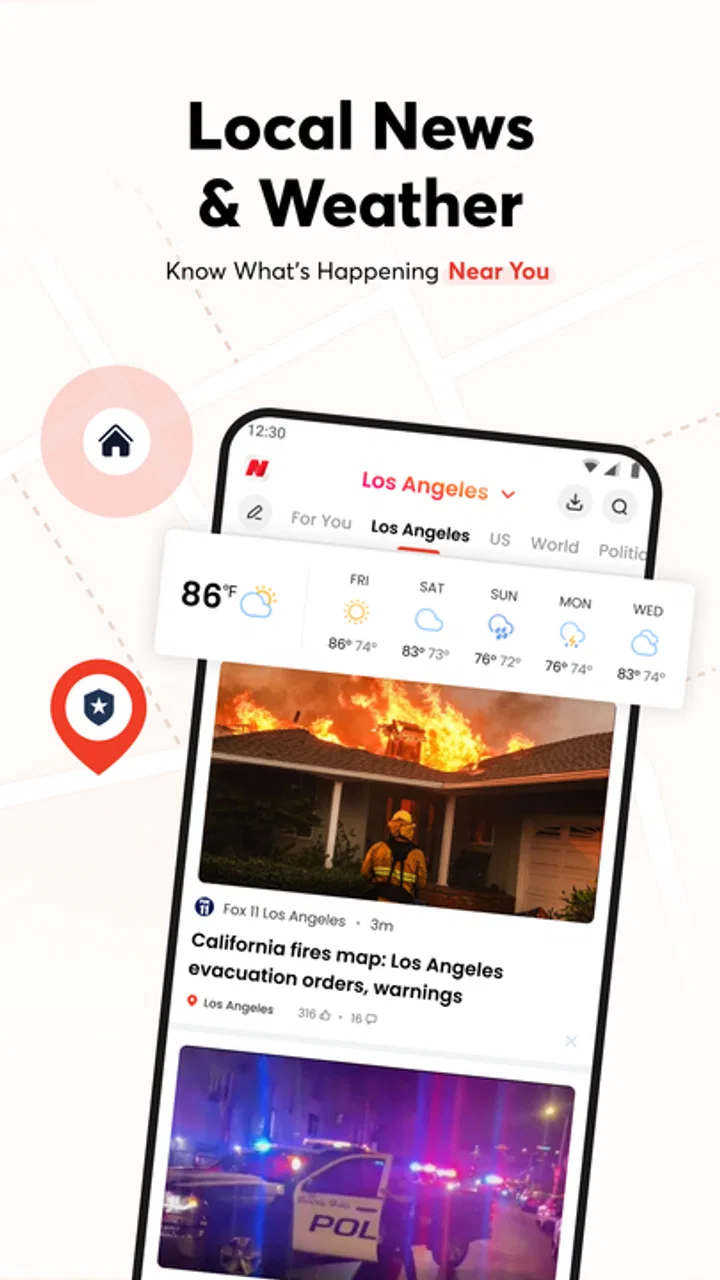
I found Local News: Headlines & Alerts most useful when I wanted a quick sense of what was happening nearby without opening several separate news sites. It is a free news and magazines app from Opera, built around local headlines, weather alerts, and important updates for the area around me. That narrow purpose gives it a clear identity: it is less about becoming my complete daily newspaper and more about giving me a fast local briefing.
After spending time with it, my view is positive but measured. The app is easy to understand, and its local focus can be genuinely helpful during a busy morning or when conditions change unexpectedly. At the same time, people who want deep reporting, extensive customization, or a full replacement for a trusted newspaper app may find it limited. Its strongest quality is convenience, especially when I need relevant information quickly rather than a long reading session.
How the app handles readability and navigation
The first thing I noticed is that the experience is organized around scanning. Headlines are easier to approach than a dense stream of full articles, which suits the way many people check news on a phone: unlock the device, look for something relevant, and decide whether to read further. The short description, “Local News,” is simple, and that simplicity reflects the app’s purpose.
You May Also Like

 AccuWeather: Weather Radar
AccuWeather Review: A Quick, Clear Forecast for Everyday Decisions
For everyday plans, the best forecast is the one you can understand quickly. AccuWeather makes rain timing, radar, and local conditions easy to act on, with a few trade-offs.

 Hill Climb Racing
Why Hill Climb Racing Still Turns Crashes Into One More Run
A tiny car, a bumpy hill and one more upgrade: Hill Climb Racing keeps resurfacing because its simple chaos makes every near-miss feel personal.

 AliExpress - Shopping App
AliExpress Makes Global Shopping Feel Personal, but Shoppers Bear the Risk
AliExpress turns a global marketplace into a pocket-sized discovery engine. Its reach is useful, its shopping loop compelling, and its trade-offs easy to miss.

 Lords Mobile: Kingdom Wars
Lords Mobile Is a Kingdom-Building Routine, Not a Quick Match
A case-by-case verdict on the building, battles, device demands, and social commitments that make Lords Mobile rewarding for some players and exhausting for others.

 PDF Scanner app - TapScanner
TapScanner Makes Paperwork Easier to Capture, Check, and Share
TapScanner makes scanning with a phone feel less like a rescue operation and more like a dependable step in getting work done. Its capture tools are useful, though not flawless.

 Block Blast!
 Shows How Much a Puzzle Game Can Leave Out
A quiet grid game shows why puzzle players increasingly value instant clarity, repeatable skill and low-pressure play—and where the genre still needs to catch up.
More From Our News Desk
View All News


I did not have to learn a complicated system before understanding what the app was for. Local stories, alerts, weather-related information, and other essential updates form a more focused starting point than the broad mixture found in many general news applications. For someone who becomes overwhelmed by national headlines, entertainment stories, opinion pieces, and endless recommendations, this narrower scope can feel calmer.
Readability depends heavily on the individual story and the phone being used, but the local-news format has one practical advantage: I can judge relevance from the headline before committing attention. That matters when I am standing at a bus stop, preparing breakfast, or checking the phone between tasks. A clear headline can save me from opening several sources just to discover that an item does not affect my area.
My preferred workflow is to use the app as a first pass. I check the local feed, identify anything that could affect my plans, and then open a fuller source when I need context. This prevents the app from becoming a noisy background habit. It also makes the distinction between an alert and a complete report easier to remember.
The app comes from Opera, a developer already associated with mobile browsing products, and that background shows in the straightforward, phone-first approach. I would not describe the interface as a research workstation. It is designed for quick orientation, not for comparing many articles side by side or building a personal archive of investigations.
One useful reading habit is to avoid treating the first headline as the entire story. Local updates can be important while still being brief. I use the headline to decide what deserves attention, then look for the source article or another reliable report before making decisions about travel, safety, school, work, or appointments. That is a sensible way to use this app without expecting it to perform the role of every other news service.
What the local focus changes in everyday use
Most news apps make me work to filter out information that is interesting but irrelevant. Here, the local angle changes the order of priorities. Instead of beginning with national or international news and searching for nearby items, I can start with the information most likely to affect my immediate routine.
A realistic example is a morning commute during unsettled weather. I might open the app before leaving home, check local headlines and weather-related updates, and decide whether to leave earlier or change my route. If the information is urgent, I can then verify details through an official transport, weather, or local authority source. The value is not that the app replaces those sources; it helps me notice that I should check them.
This also works for people who have recently moved to a new area. A local feed can provide a quicker introduction to the concerns and events that shape daily life there than a national news homepage can. However, I would still combine it with a local newspaper, community source, or official channel if I needed a complete picture.
Using it across abilities and different situations
I find it useful to think of accessibility as a match between the app, the phone, and the moment I’m in—not as a feature that works identically for everyone. A quick local check may suit a short break, while larger text or assistive controls can make the same task more comfortable on another day. That practical flexibility leads naturally to considering how different users can shape their routine around the app.
Motor considerations when speed matters
For users with limited dexterity, the biggest question is not simply whether the app looks clean. It is whether the essential action can be completed without repeated, precise gestures. A local-news app is most useful when checking an update takes only a few deliberate taps rather than a long chain of small controls.
I found the focused purpose helpful in this respect. There are fewer reasons to wander through unrelated sections, so the task can remain short: open the app, scan the relevant item, and decide what to do next. That can reduce fatigue for someone who finds prolonged scrolling or repeated navigation uncomfortable.
There are still practical trade-offs. News feeds naturally encourage vertical scrolling, and scrolling can be tiring or difficult for some users. A person who relies on a larger touch target, a particular device setting, or an assistive input method should test how comfortably the feed responds on their own phone. I would not assume that a simple layout automatically solves every motor-access need.
My advice is to configure the phone itself before judging the app. Larger system text, display scaling, touch-and-hold adjustments, voice control, or an external input device may make more difference than any individual news screen. The app can be part of an accessible setup, but the overall experience depends on the operating system, hardware, and the user’s preferred method of interaction.
Visual and sensory comfort
Local information is often consumed under imperfect conditions: outdoors in bright light, late at night, while tired, or during a stressful event. That makes visual comfort important. I appreciate that the app’s purpose encourages short visits, because a quick check is less demanding than reading a long stream of content.
Still, headlines can vary in length and contrast depending on how they are presented, and not every user will find the same text size comfortable. People with low vision may need to rely on the phone’s magnification, larger text, or other display adjustments. Those tools can help, although enlarged text may also mean more scrolling, creating a trade-off between readability and navigation effort.
For users who are sensitive to motion, rapid updates, or visual clutter, the best approach is to keep the experience task-based rather than leaving it open continuously. I would check for the information I need and close the app instead of using it as a constantly changing screen. That reduces distraction and avoids turning local alerts into a source of unnecessary sensory pressure.
People who cannot comfortably read small text should also remember that a headline is not always enough. If an alert affects a safety decision, I would confirm it through a source that offers the clearest available explanation, and I would use text-to-speech or screen-reading tools where appropriate. The app can point me toward a relevant update, but accessible understanding may require the phone’s built-in assistance or another source.
Situational access for busy and stressful moments
The strongest accessibility argument for this app is situational rather than technical. I can imagine using it with one hand while carrying groceries, during a short break at work, or before leaving for an appointment. The local focus reduces the time spent searching, which is valuable for anyone with limited attention, limited energy, or a temporary injury.
It can also help people who do not want a constant stream of global news. Someone managing anxiety, recovering from illness, or trying to reduce screen time may prefer a small, purposeful check of nearby developments. I would use it with a clear boundary: check the local situation, follow up on anything important, and stop browsing.
For older adults or people unfamiliar with complicated news platforms, the app’s limited promise may be reassuring. They do not need to understand a large network of sections before finding local headlines. A family member could help set up a routine around it, such as checking once in the morning and once before travel, rather than encouraging constant notifications or repeated refreshing.
That said, situational access has limits. During an emergency, I would never rely on a single news app as my only channel. Official emergency services, local authorities, transport operators, and weather services may provide the most direct instructions. Local News: Headlines & Alerts can help me notice a developing situation, but noticing is not the same as receiving an official command.
Where the experience still creates barriers
The app’s simplicity is also its main limitation. If I want detailed source comparison, long-form investigative work, specialist reporting, or a carefully organized reading list, I would choose a full newspaper app, an RSS reader, or a browser instead. Those alternatives can require more setup, but they usually give me greater control over what I read and how I organize it.
Another barrier is the possibility of treating local relevance as complete coverage. A short local headline may omit background, uncertainty, or the difference between an early report and a confirmed outcome. Readers who need precise information for work, caregiving, travel, or safety should follow the story beyond the initial summary.
People who need highly specific accessibility controls may also prefer a service whose interface and reading options they already know work well with their setup. I would not choose this app solely because it is less complicated. I would install it, test the main reading path, adjust the phone’s accessibility settings, and keep it only if checking a local update feels comfortable and dependable.
There is also a cognitive consideration. Alerts and urgent wording can make every item feel equally important, even when it is not. I find it helpful to pause and ask three questions: Does this affect me directly? Is there an action I need to take? Do I need confirmation from an official source? That small routine keeps the app useful without letting it dictate my attention.
Who should use it and who should look elsewhere
I recommend trying it if your main need is a fast local briefing, especially when weather or nearby developments can change your plans. It is also a reasonable companion app for someone who already follows a trusted newspaper or official information service but wants an easier first look at what is happening nearby.
I would be less enthusiastic for readers who want a complete news subscription experience. If your priority is deep analysis, international coverage, saved articles, extensive personalization, or a carefully curated reading library, another category of app will probably suit you better. A browser may be preferable when you want to visit official sources directly, while a dedicated newspaper app may offer more depth and editorial continuity.
The app is free, which makes experimenting straightforward. It is intended for Everyone 10+, and it runs on Android devices using version 6.0 or later. Its current version is 13.6.2254.81115. Those details make it approachable for people using older compatible phones, although actual comfort will still depend on screen size, performance, and the device’s accessibility settings.
Its audience is already substantial: the app has passed one million installs, with an average rating of 4.5 from around twenty-six thousand ratings and roughly two thousand three hundred written reviews. I see those figures as evidence that the basic idea works for many people, not as a guarantee that every local feed or every accessibility setup will feel equally good.
My inclusive verdict after using it
Local News: Headlines & Alerts is at its best when I treat it as a calm doorway into nearby information. It reduces the effort of finding local headlines, supports short reading sessions, and can be useful for people whose attention, energy, vision, or mobility varies from day to day. The local focus is more than a label: it changes the app from a broad news stream into a practical check-in tool.
The most inclusive way to use it is as a starting point, not a single source of truth. I would pair it with the phone’s own accessibility features, verify urgent information through official channels, and avoid leaving alerts running when they create stress or distraction. That approach respects both the app’s strengths and its boundaries.
Opera has made a focused free app rather than an all-purpose newsroom. I like that honesty of purpose. It will not satisfy everyone, and I would choose a deeper news service when context or control matters most. But for a reader who wants nearby headlines and weather-related updates in a quick, approachable format, I think it is worth trying. The deciding test is simple: can you open it, understand the local situation, and act on what matters without unnecessary effort? For many users, the answer should be yes.
FAQs for Local News: Headlines & Alerts
01What features does Local News: Headlines & Alerts offer?
Local News: Headlines & Alerts provides real-time updates on local news, weather, and traffic conditions. Users can customize their feed to focus on topics of interest, receive push notifications for breaking news, and access multimedia content such as videos and photo galleries. The app also supports location-based alerts to keep you informed about events in your vicinity.
02Is Local News: Headlines & Alerts free to use?
Yes, Local News: Headlines & Alerts is free to download and use, though it may include ads. There is also an option for a premium subscription that removes ads and offers additional features such as exclusive content and early access to certain news stories. This helps support the developers and improve the app's offerings.
03How does Local News: Headlines & Alerts ensure the accuracy of its news?
Local News: Headlines & Alerts partners with reputable local news outlets and journalists to deliver accurate and reliable information. The app employs a rigorous editorial process to verify news stories before they are published. Users can also report inaccuracies, ensuring a community-driven approach to maintaining the integrity of the news provided.
04Can I customize my news feed in Local News: Headlines & Alerts?
Absolutely. Local News: Headlines & Alerts allows users to tailor their news feed based on their interests and preferences. You can select specific topics, such as politics, sports, or entertainment, and prioritize them in your feed. Additionally, you can choose to follow particular news outlets or journalists for a more personalized news experience.
05Is my privacy protected when using Local News: Headlines & Alerts?
Yes, the app is designed with user privacy in mind. Local News: Headlines & Alerts only collects minimal data necessary to provide the service, such as location for local alerts. Data is handled according to strict privacy policies, and users have the option to opt-out of location tracking or adjust privacy settings to control the information they share.
Pros
- Timely local alerts keep you informed.
- Customizable news categories.
- Easy-to-navigate interface.
- Minimal ads for a smoother experience.
- Offline reading mode available.
Cons
- Limited international news coverage.
- Occasional notification delays.
- Requires account for full features.
- In-app purchases for premium content.
- No dark mode option.

Local News: Headlines & Alerts
Gallery